Unveiling the True Essence of ‘Murti’ and ‘Vigraha’ in Hindu Worship
Beyond Labels and Misconceptions
As the joyous festivities of Ganesh Chaturthi sweep through the land, one word echoes in the air: “idol.” For centuries, the Western world has cast India as the realm of idols and idolaters, often using these terms to belittle Indian traditions while elevating Abrahamic faiths as more progressive. But is there more to this than meets the eye?
In the world of Indian art and spirituality, the term ‘icon’ is often used to describe metal figurines, like bronze icons. Conversely, ‘idol’ typically refers to a figurine or statue worthy of worship. However, these labels barely scratch the surface of the profound meanings hidden within the words ‘Murti’ and ‘Vigraha.’
The Living Embodiment: Murti
‘Murti’ is more than a lifeless idol; it embodies something, living on after a consecration process known as ‘prana prathishta.’ This sacred transformation renders it far from lifeless; it becomes a living representation of the divine.
Understanding ‘Graha’ and ‘Vigraha’
To grasp the significance of ‘Vigraha,’ we must first explore the root word ‘Graha.’ In the context of Indian astronomy (Jyotisha), ‘Graha’ goes beyond mere planets. It signifies any object in space that occupies a specific place. This includes lunar nodes like Rahu and Ketu, which occupy space during eclipses.
The term extends to daily life too. A wife is referred to as ‘grahini,’ signifying her as the queen of the household, while her husband is called ‘grahastha,’ indicating his role as the occupant of the home with his family. ‘Graha’ denotes the act of occupying a marked space, whether it’s physical or emotional, gross or subtle. Even at the atomic level, where particles seem minuscule, they still occupy space.
Murti: A Multifaceted Occupant
The ‘Murti’ you worship occupies space in two profound ways:
- Physical Presence: As a physical entity, it occupies a defined space on the Earth. It stands as a tangible representation of the divine in our material world.
- Heartfelt Presence: Beyond the physical realm, the ‘Murti’ finds a special place in your heart. Here, it’s not just a physical object; it’s a ‘Vigraha.’ The prefix ‘vi’ signifies its unique and cherished status. It’s deeply entrenched in the realm of the divine and occupies a special place in your heart and home.
A Path of Surrender: Puja and Vigraha
Murti and Vigraha aren’t mere objects; they are conduits to the divine. Puja, the act of worship, becomes a beautiful way to surrender everything to the divine through these forms. It’s a means to pour out your love, devotion, and offerings, both inner and outer.
While European visitors may have seen Murti and Vigraha as mere works of art, for those filled with ‘bhakti’ (devotion), these forms occupy a sacred space within their hearts. It’s not idolatry but adoration, a profound connection with the divine.
A Call for Change: Embrace Murti and Vigraha
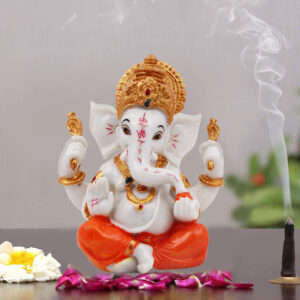
As we celebrate Ganesh Chaturthi, a time when millions bring a Murti of Lord Ganesha into their homes and perform pujas for ten days, it’s a perfect opportunity to shift our perspective. Let’s resolve to refer to these embodying forms of divinities as ‘Murti’ or ‘Vigraha’ instead of ‘idols.’ It’s time to change the narrative and recognize the special place they hold in the hearts of devotees.
May Lord Ganesha, the remover of obstacles, pave the way for this transformation, where we honor the essence of ‘Murti’ and ‘Vigraha’ as bridges to the divine.