A NEW DAWN, A NEW YEAR

A Heartfelt New Year Message — From My Heart to Yours
As we step into this New Year, I can’t help but look back with gratitude.
I started life in a small house, with humble beginnings and meagre resources – a family of five raised on my father’s modest income, holding tight to hope and hard work. Watching my elder sister and younger brother, I learned early that dreams don’t wait for perfect conditions. They are built with faith, grit, and sweat.
I worked my way up, climbed rung by rung, and reached places I once only dreamed of. But along the way, I also fell – caught in bad company, harmful habits that weighed heavy, and distractions that tested my spirit.
What pulled me up wasn’t luck. It was resilience — the refusal to quit. It was the values that became my compass:
Dream, Think & Do Big | Talk Straight | Stay Humble | Work Hard.
These weren’t just mantras. They were lifelines.
And when life knocked me down, it was gratitude that steadied me, love that reminded me where I belong, and community that carried me when my legs tired.
Today, I stand here because of all that — not in spite of it.
If I stand steady today, it is because four companions hold me close:
- Gratitude keeps me humble.
- Resilience keeps me moving.
- Love keeps me human.
- Community keeps me grounded.
These four protect me from going astray.
So, for this New Year, here’s my wish for you:
- May you carry forward your dreams, no matter how unpolished they may seem.
- May resilience rise in you like a second heartbeat when life gets hard.
- May gratitude fill your mornings and love fill your evenings.
- May your community be your strength and your cheer — in good days and tough ones alike.
If the past year taught us anything, it’s this: every challenge is an invitation to grow; every setback is a lesson in disguise; and every new day — especially the first of the year — is a chance to begin again with more wisdom, more heart, and more courage.
So here’s to growth and grace.
Here’s to dreams that stay big — and efforts that stay humble.
Here’s to the year ahead — full of hope, meaning, and beautiful possibilities.
Happy New Year — from my heart to yours.
— S.J.
Khairtabad – The Place That Raised Me
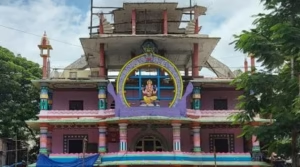
Khairtabad! Ahhh… even saying the name feels like exhaling a memory. A small area on the banks of Hussain Sagar Lake, right at the heart of Hyderabad. There’s a portion of me that still exists here, quietly tucked between its streets and stories.
Life always seemed to slow down in Khairtabad.
You breathe a little easier here.
People look at you like they’ve known you forever – because, in some strange way, they have.
Every corner hides a piece of my past – tears of poverty, pangs of hunger, unpaid loans, and yet, laughter that still echoes, a mistake that still teaches, a friendship that never really ended.
Even the smallest things here feel familiar, the sound of the evening temple bell, the grand Bada Ganesh festivities that turned our streets into a sea of colour and noise, the aroma of chai from the old hotels, the narrow lanes that somehow, always, found a way to lead me home.
The best part of my youth was spent here, long before I became a “writer” and an “author.”
This was the place that saw me in my rawest form. The version of me that was still figuring life out – dreaming quietly, laughing loudly, getting drunk with friends & acquaintances, street brawls (fights) that ended in blood (and laughter the next morning), failing without guilt or shame, falling without fear.
Khairtabad has this strange way of humbling you and healing you at the same time. It constantly reminds me of the people who shaped me — my Pappa, my teachers, those Annas who ruled the area like big brothers, those Tammis who served with no returns (never turning their backs on you), the friends who became family, and the strangers who somehow never felt like strangers.
There’s a comfort in knowing that no matter how far life takes you, there’s this one place where you don’t have to prove anything. You don’t have to wear your titles, your achievements, or your exhaustion. You just show up — as yourself — and that’s enough.
That’s what Khairtabad does to me. It strips away the noise and brings me back to the person I was before the world told me who I should be.
Every time I walk those streets, I feel a quiet gratitude.
For the pain,
for the laughter,
for the lessons,
for the love that never left.
Khairtabad isn’t just a place. It’s a heartbeat – one that still beats somewhere inside me. And every time I come back, it reminds me – this will always be home.
— Sanjay Shukla (S.J.)
Why the Word Spirituality Never Existed in India’s Dharma – A Memory from Varanasi

It was twenty-five years ago, in Varanasi.
I had run away from Hyderabad, weighed down by debts, confusion and questions. A friend, worried that I might lose myself, took me to meet a sadhu. He said, half-joking and half-serious, “Maybe this man can make you see sense and send you back.”
The meeting happened in an old house by the Ganga, its verandah open to the afternoon sun. The light filtered through peepal leaves, and a brass fan creaked slowly above. The air was thick with the smell of incense and river breeze. From somewhere not too far away, the temple bells chimed, as if Varanasi itself was keeping rhythm with our conversation.
The sadhu sat before me, calm, unhurried, a simple dhoti draped over his lean frame. My friend slipped into the background while I sat awkwardly and restlessness. I still remember how hesitant I felt: half-defensive, half-curious.
“So,” the sadhu asked, his voice gentle, “why are you here?”
I mumbled something about searching for spirituality. That word sounded grand in my head, and I expected it to impress him. But he smiled, as if he had been waiting for that very word.
“Beta (my son),” he said, “There is no such word in Bharat. Our sages never used it. We had only Dharma.”
I looked at him, puzzled. “Everywhere I had read or heard, India was called a land of spirituality.” I said
“That is what tourists and ashram brochures say,” he replied with a glint in his eyes. “ But our ancestors did not escape life in the name of the divine. They never separated life into spiritual and material. That division came from Europe. There, the Church became spiritual, the King became material, and science was branded the enemy of God. When Galileo looked through his telescope, he was dragged to trial.”
“Here, our sages looked at the stars, calculated eclipses, stitched wounds, and debated existence itself. They needed no permission from God to seek truth, because for them, truth itself was sacred” he added.
I found myself leaning in, caught by the clarity in his words. He spoke of Aryabhata, Sushruta, Kapila, men who were both seekers and scientists, whose search was guided not by commandments but by Dharma, the natural law of cause and effect.
“What about God then?” I asked.
He laughed lightly. “Some scriptures said yes, some said no, some said maybe. Belief was optional. What mattered was Dharma. Can you imagine preaching atheist philosophy inside a church? You would be chased out. Here, it was debated openly.”
I asked about rituals, temples, and Gods. He explained how life’s milestones – birth, marriage, even death – were family duties, never temple decrees. Temples, he said, were never headquarters of God’s bureaucracy. They were places for devotion, art and community. Even Artha (wealth) and Kama (desire) were not sins, but goals of life to be pursued alongside Dharma and Moksha. “Why should joy carry guilt?” he asked. “Why should prosperity be shameful?”
The temple bells rang again, softer now, as if underscoring his words.
“In your world,” he said, “spirituality means escaping life to find God. In ours, Dharma means holding life itself as sacred, seeing God in every drop of it.”
“Dharma is not about renouncing,” he said. “It is about embracing. To live as a son, a friend, a worker, a seeker – fully, honestly – that is Dharma. When you love your duties, when you perform them with care, they cease to be burdens. They become worship. Joy comes not from fleeing life, but from being present in it.”
I sat silent. I realized in that moment how much I had misunderstood. I had thought the divine lay hidden behind the clouds, accessible only by withdrawal. He showed me instead that the divine was already here—in rivers, in mothers, in friends who pull you back when you drift too far, even in the restless heart of a runaway.
That sentence struck me like lightning. I sat silent. The Ganga moved quietly beyond the verandah. A soft breeze carried the sound of children laughing nearby. I realized in that moment how much I had misunderstood.
I had come to Varanasi as a runaway, carrying questions that had no answers. I left that verandah carrying something far greater: the realization that I didn’t have to escape the world to find the divine.
The divine was already here: in the soil, the river, the people, even in the restless heart of a runaway.
I left that house changed. I had come to Varanasi to escape, but the sadhu’s words sent me back – not as a defeat, but as a return. A return to my duties, to my roles, to the simple truth that life itself was sacred.
That day, Varanasi gave me not just peace, but a truth I have never forgotten: India never needed the word spirituality. It always had Dharma. Dharma was enough! Dharma did not ask me to flee my responsibilities in search of God. It asked me to discover God in fulfilling them.
An Angel Who Walks Beside Me
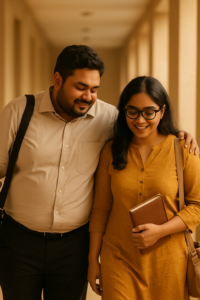
It’s not rain this time. It’s something else, something quieter, yet more powerful, that changed me. You see, there are moments in life when a person walks in…not with fanfare, not with noise, but with the quiet strength of love and kindness. And suddenly, the broken pieces of your heart start finding their way back together.
That person, for me, was a colleague. A co-worker who slowly became much more – a sister, a mother, a friend. Someone who held space for my nonsense, listened without judgment and reminded me that even in the darkest corners, light can be found.
We had been working in the same place for years, six of them to be exact. But my respect and affection for her grew not from routine meetings or casual office chatter. It began when I learnt her story.
She had come to this city alone, carrying the hand of her little boy — barely 9 or 10 years old. She had nothing but grit in her eyes, courage in her chest, and the stubborn determination to build a life from scratch. No backup, no safety net. Only her child, her strength and faith in herself.
That revelation shook me. At a time when I myself was losing my ground — struggling with my own mind, my personal demons, my silent battles — her presence became an anchor. While I was slipping into shadows, she was the one who pulled me back toward light.
She stood by me with patience that only love can teach. She cajoled me when I resisted, scolded me when I gave up, and reminded me – every single day – that healing was possible. That I was more than my failures, more than my pain.
Her love wasn’t romantic; it was something deeper. It was the love of someone who sees your wounds yet refuses to let you bleed alone.
She was a little sister when I needed mischief, a mentor when I craved guidance, and at times, a silent punching bag who absorbed my mood swings without complaint. Above all, she was a friend – one with the rare patience to let me pour out my endless rambling, never once making me feel small.
And today, when I look back, I know this much: some bonds defy logic. We are born to different mothers, shaped by different worlds and circumstances, yet when our paths cross, something probably ancient awakens – an instant connection that touches our lives. Call it karma, call it the echo of past lives, but I know this: some relationships are written long before we meet.
And slowly, without even realising it, I healed. My laughter returned, my hope returned, and with it, my belief that life still had meaning.
I don’t know what time will do. Life has a way of scattering people, of pushing such angels away when you least expect it. But I pray, with all my heart, that I don’t lose her to time. Because she has been more than a colleague, she has been proof that love and kindness can heal, that hope can be reborn, and that sometimes, one person’s courage is enough to rewrite another person’s story.
And if you ask me what love is, or what kindness is, I would say it is simply someone standing beside you when you can’t stand at all.
That, to me, is her gift. That, to me, is why I believe in kindness. And that, to me, is why I believe angels still walk among us.
Missing the Carefree 80s–90s: When Life Was Simple, Laughter Was Real, and Memories Weren’t Made on Screens

There was a time—not too long ago—when joy wasn’t downloaded, but discovered. When friends didn’t need Wi-Fi to connect, and “status” had nothing to do with blue ticks or filters. We’re talking about the 80s and 90s—those golden decades where life was delightfully analog, gloriously unpredictable, and beautifully imperfect.
Back then, happiness had a different ringtone.
It was the jingle of an ice cream cart down the street…
The screech of a chalk against the blackboard…
The rustle of comic book pages under a blanket with a flashlight after “lights out.”
The sheer thrill of Sunday morning cartoons—He-Man, Shaktimaan, or The Jungle Book intro that still echoes in the minds of every 90s kid.
Time wasn’t tracked by digital clocks, but by Doordarshan’s iconic countdown.
Afternoons smelt like pencil shavings, fresh rain on mud, and mom’s tadka. Evenings were for playing outdoors until the streetlights came on—no GPS, no Google Maps, just a mental record of gullies, shortcuts, and secret hideouts. Bruised knees were worn like badges of honour.
Weekends? They weren’t for Netflix. They were for nimbu paani, Ludo, Antakshari, and the latest gossip whispered during a power cut.
And oh, the joy of handwritten letters!
We waited weeks for those blue inland envelopes. Long-distance calls were precious and brief—timed to the second. Photos weren’t clicked in bursts but taken with caution, with film rolls where every frame mattered. And when developed, they came back with grainy surprises, red eyes, and imperfectly perfect memories.
School life wasn’t about screenshots—it was about slam books.
We scribbled secrets, doodled dreams, and signed off with “Don’t ever change.” Birthdays meant hand-drawn cards and cassettes taped with favourite songs. Crushes bloomed on last bench glances, not dating apps. And heartbreaks? Healed with warm tea, a friend’s shoulder, and time—lots of time.
There were no algorithms deciding what we liked.
We discovered things. We felt them.
And most importantly, we lived them.
Why do we miss those days?
Because they remind us of who we were—before life got pixelated.
When we measured moments in laughter, not likes.
When connection meant eye contact, not mobile data.
When attention wasn’t a currency and presence wasn’t performative.
No screen, no swipe, no status update—just real stories. And us, living them fully.
So here’s to the 80s–90s.
To simpler times, deeper bonds, and a world that asked us to look up, not down.
We didn’t have it all. But we had enough.
And somehow, that was everything.
Do you miss those days too? Share your favourite memory below—before we forget how to remember.
What My Grandmother Revealed: The 10 Lies of the Brahma Kumaris — A True Story that Shook My Faith in What I Thought Was Spirituality
I never imagined that one afternoon in 2014 would unravel a mystery that had begun silently fourteen years earlier.
Let me take you back.
It was the year 2000. I was still young, brimming with curiosity, with just enough exposure to philosophy to ask annoying questions at family functions. But that year, my family wasn’t coming together for food or festivals. There was a storm brewing. A bitter dispute had broken out over the ancestral properties of my grandmother’s sister — technically also my grandmother — and her sons and daughters.
They weren’t your average landholding family. They were Rajputs — royal lineage. We’re talking hundreds of acres of farmland, ancestral houses, and yes, a fort — a real fort — nestled in Kamareddy district, Telangana. The land stretched across the borders into Maharashtra and Karnataka. This wasn’t mere property; it was legacy.
But legacy turned into legal warfare when my grandmother decided to do something that shook the whole family: she declared that after her husband’s death, she would donate her share of the estate to the Brahma Kumaris, and live the rest of her life in their ashram.
I had barely heard of the organization until then. They sounded like one of those quiet spiritual communities, maybe vegetarian, probably into yoga and white clothes. I was mildly curious, but I let it pass. “To each their own,” I thought.
She stayed firm. She donated her entire share — a significant chunk of land, no less — to Brahma Kumaris. Her children were devastated, but couldn’t legally stop her. And so, off she went to the ashram.
Fast forward to 2014.
Fourteen long years had passed. She was in her 70s now, and suddenly, she requested a family gathering. She insisted all close relatives come on a particular date. I sensed something serious. Not the usual ceremonial speech of old age. She sounded determined. Urgent.
That day arrived. There she was, draped in white, back in her son’s home after more than a decade in the ashram. What followed next was something that shook everyone present.
She said, and I remember her words clearly, “I was betrayed. All these years, I was living a lie.”
She confessed that the Brahma Kumaris had misled her — not through force, but through sweet words, spiritual jargon, and a meticulously crafted illusion. Her voice cracked when she said, “It’s not what it seems. Their entire philosophy is flawed.”
Now, I had studied a fair bit of philosophy by then — Plato, Advaita, even Buddhist texts. So I asked her: “Tell me the specifics. What exactly is flawed?”
She took a deep breath. Then, point by point, she listed what she called the 10 Great Lies of the Brahma Kumaris.
Let me tell you what she told me that day.
- The Universe Is Only 5,000 Years Old
They teach that the entire universe, from creation to now, is just 5,000 years old — and that it repeats exactly the same way every 5,000 years, like a film reel on loop.
My grandmother scoffed. “Even a schoolchild today knows the Earth is 4.5 billion years old, and the universe is nearly 13.8 billion. Dinosaurs existed, ancient civilizations flourished and fell — how can all of that be squeezed into 5,000 years?”
Worse, they call this “scientific.”
- Doomsday Will Happen in 2036 (and Only They Will Survive)
Apparently, the world is set to end in 2036. Over 8 billion people will die, and only Brahma Kumaris will inherit the new world — “heaven on Earth.”
But this isn’t their first prediction. They’ve declared the world would end in 1942, 1945, 1950, 1976, 2000, and 2012. Each time, they were wrong. Like other cults, they just quietly change the date.
Yet people believe them.
- Heaven Existed 2,500 Years Ago—and It Will Return
They say that 2,500 years ago, Earth was a literal heaven, and that paradise will return after this mass destruction — but only for them.
But what about the Indus Valley, the Egyptians, the Mayans? What about carbon dating, archaeology, or just common sense? How does their neat 5,000-year timeline explain any of it?
It doesn’t.
- Only Brahma Kumaris Know the Truth; All Other Religions Are False
This was the claim that made me most uncomfortable.
According to them, God Himself founded their organization and speaks through Dada Lekhraj even today. All other faiths — Christianity, Islam, Buddhism, even mainstream Hinduism — are false. Their followers are “impure.” Only Brahma Kumaris are “truly enlightened.”
I remember asking, “What about compassion? What about humility?” My grandmother said, “That’s not their currency. Their currency is superiority.”
- Dada Lekhraj Is God’s Medium, Vishnu, Krishna, Ram—all in One
They believe that their founder, Dada Lekhraj, is the vessel for God, the reincarnation of Lord Krishna, Lord Vishnu, Lord Ram, and even God Himself.
And the discourses he gave, called Murli, are considered more authoritative than the Vedas, Puranas, or even science.
“Where,” I asked, “in any Hindu scripture does it say that God will appear in the body of a Sindhi diamond merchant in the 1930s?”
She smiled sadly. “Exactly.”
- Only Their Raja Yoga Is the Real Spiritual Path
They’ve trademarked Raja Yoga, claiming only their version is true and “scientific.” They say it’s the only path to spiritual enlightenment.
But Patanjali spoke of Raja Yoga centuries ago. Swami Vivekananda explained it to the West long before Brahma Kumaris were founded.
They didn’t invent it. They just branded it.
- Husband and Wife Are Brother and Sister
This one shook me.
According to their doctrine, married couples must live as brother and sister. Physical intimacy is forbidden. They don’t reveal this to newcomers. It’s told slowly, subtly, once you’re already emotionally invested.
Can a society function on such beliefs? What kind of psychological toll would that take?
- The Gita Was Not Spoken by Krishna—but by Shiv Baba
Every Hindu child knows the Bhagavad Gita is a dialogue between Krishna and Arjuna.
But Brahma Kumaris teach that Lord Krishna is not the speaker — it’s their version of God, Shiv Baba, speaking through Dada Lekhraj.
They even claim Krishna’s version is wrong. “This is rewriting history in God’s name,” my grandmother said.
- Shiv and Shankar Are Not the Same
They teach that Shiv and Shankar are two different entities.
But in every mainstream Hindu scripture, these are just different names for the same Supreme Being — Shiva.
This division is artificial, invented to fit their belief structure.
- “World is One Family”—But They Are Internally Divided
They preach Vasudhaiva Kutumbakam — “the world is one family.”
Yet, within their own organization, there are splits, factions, and internal rivalries. And if a family member (like my grandmother) later wants help, they are often ignored.
They follow rules, not relationships.
Final Thoughts
I asked her, “Why didn’t you realize this earlier?”
She replied, “Because they don’t tell you these things upfront. It starts with a sweet voice, a 7-day course, a daily Murli. Slowly, your thoughts change. You begin to believe that the rest of the world is wrong, and only you are right.”
She looked around the room that day, her eyes welling up, and said, “I lost years of my life. Don’t let others lose theirs.”
So here I am, sharing this story with you. Whether you’re 19 or 70, spiritual or skeptic — take a moment. Set aside beliefs, just for a few minutes. Think clearly. Reason deeply.
When spirituality becomes control, and love becomes doctrine, truth is the first casualty.
Don’t give it up without a fight.
And if my grandmother — a woman of strength, wisdom, and courage — could walk away after 14 years inside, maybe someone else reading this can find their way out too.
Or better yet — never walk in.
© Based on true events. Shared so you stay informed, aware, and free.
THE UNVARNISHED TRUTH


They gunned him down in broad daylight—his life extinguished in seconds before his bride’s horrified eyes.
His identity as a Dalit, Brahmin, Rajput, Jat, Gujjar or Kayastha? IRRELEVANT.
Whether he spoke Marathi, Telugu, Malayalam, Tamil, Gujarati, Bengali, or Assamese? MEANINGLESS.
If he voted for BJP’s Modi, Congress’s Rahul, AAP’s Kejriwal, or TMC’s Mamata? INSIGNIFICANT.
In that brutal moment of execution, they (Islamic Terrorists) didn’t ask if he was:
- A devout Shaivite who worshipped Lord Shiva
- A dedicated Vaishnavite who followed Lord Vishnu
- An Arya Samaji reformist
- A rational Charvaka atheist, or even
- A syncretic Shakta who embraced the Divine Mother.
They didn’t care if he visited temples daily or merely during festivals, if he chanted mantras or questioned religious orthodoxy.
In that brutal moment, everything that defined him—his dreams, his politics, his secular beliefs about harmony and coexistence—evaporated into nothingness.
Why?
Because, to his killers – Islamic Terrorists, he (the victim) embodied only one thing: a Hindu, non-believer. An infidel. A KAFIR.
His Hindu identity—the sole reason they pulled the trigger.
This is not a story about political differences that can be debated or cultural misunderstandings that can be bridged. This is the raw, bleeding reality that many refuse to confront: a man’s existence violently terminated for the crime of being born into the wrong faith.
Forget all your comfortable narratives. Throw down the polite excuses.
Face the searing truth that burns through all our carefully constructed illusions of tolerance.
When hatred flows this deep, when it targets the very essence of who you are rather than what you believe or how you vote, we must finally open our eyes to all those lies (we are fed) before us.
This is the terrible, naked truth we can no longer afford to ignore.
- Shukl ‘Jigyasu’
Long-Form Content: The Forgotten Path to Deep Thinking and True Attention
Building Patience in a Click-Driven World

What if the very thing you’re trying to escape—boredom, slowness, silence—is actually the key to unlocking sharper thinking, stronger focus, and a more grounded life?
In a world obsessed with speed, swipes, and surface-level takes, long-form content can feel like a quiet rebellion. It doesn’t promise instant answers or quick dopamine hits. Instead, it offers something far more valuable: the ability to sit with complexity, to think deeply, and to grow in patience—one paragraph at a time.
And perhaps that’s exactly why we need it now more than ever.
Let’s go deeper together. Stick around — it’s worth the scroll.
In an era where the average attention span has reportedly dipped below that of a goldfish, long-form content often feels like a relic—something quaint and indulgent, like handwritten letters or Sunday crossword puzzles. But here’s a quiet truth that rarely gets airtime in our feed-refreshed world: long-form content is essential for the very thing it promotes—patience and perseverance.
And perhaps that’s what makes it radical.
The Paradox of Instant Information
Today, ideas are served in 280 characters. Advice is packaged in bite-sized reels. Complex topics—whether geopolitical conflicts or ancient philosophy—are explained in 60-second clips. And while this snackable content has its place, it comes with a hidden cost: it atrophies the very muscle needed to digest life’s most meaningful insights.
Think of your brain like a muscle. If all it ever lifts are featherweight ideas—“5 Hacks to Be More Productive” or “This One Trick Will Make You Happy”—it will never develop the strength to carry weighty thoughts. And weighty thoughts are where transformation happens.
The Deep Work of Wrestling With Ideas
In the early days of my writing career—before smartphones lit up our palms every ten seconds—I interned under a senior editor at a health magazine. He once handed me a stack of scientific journals and said, “Find the story.” It was tedious work. I spent days combing through dense text on autoimmune responses and hormone imbalances. I remember nearly quitting out of frustration.
But in that struggle, I found a profound joy—the satisfaction of discovery, the patience to connect dots, and the humility to admit that understanding takes time. That single experience shaped how I approached every assignment thereafter. It taught me that some ideas require effort to access, and that effort is what makes them meaningful.
And here’s the thing: if an idea can be handed to you on a platter, it likely isn’t deep enough to change your worldview.
A Reader’s Journey: From Scroll to Stillness
A few years ago, I wrote a 3,000-word piece on chronic pain for a hospital group. It wasn’t flashy. No clickbait title. No GIFs. Just one woman’s journey from a debilitating condition to a manageable life with the help of a multidisciplinary approach. Weeks later, I received an email from a reader who had forwarded the article to her husband—also living with chronic pain. He printed it out. Annotated it. Took it to his doctor. That single article helped him ask better questions and, ultimately, choose a new therapy that worked.
That’s the power of long-form: it invites stillness, introspection, and change.
The Antidote to Dopamine Dependency
We’re living in the age of the dopamine loop. Every ping, like, or swipe is a mini reward that wires us for novelty and instant gratification. It’s a neurological trap—and it’s rewiring our brains in ways that make it harder to engage with complexity.
But when you commit to long-form—whether reading it or writing it—you’re doing something rebellious. You’re saying, “I will sit with this. I will engage. I will think.” And in doing so, you’re building patience, focus, and a decreased need for constant stimulus.
It’s like training for a marathon in a world obsessed with sprints. And those who can run the intellectual marathon will be the ones capable of navigating life’s more difficult, nuanced paths.
The Writer’s Responsibility
As content creators, we owe it to our readers to give them more than just sugar. We owe them substance. Not every piece needs to be long, but those that aim to shift perspectives, educate deeply, or inspire enduring change, cannot be compressed without compromise.
We must trust our audience enough to know they can go deeper—and invite them to do so.
In Closing: Wrestle With Words, Wrestle With Self
In the quiet of a long read, you’ll often find echoes of your own life. You’ll find arguments that frustrate you, truths that challenge you, and moments of clarity that stay long after the browser window is closed.
So go long-form. Wrestle with the words. Let them frustrate you, stretch you, change you. And in that wrestling, build something our world desperately needs more of—patience.
Because attention is not just a skill. It’s a form of love.
Boxing – The Classroom of Life


Boxing taught me what schools and colleges never could.
It didn’t just teach me how to throw a punch.
It taught me how to take one—straight on the face—and stay calm.
How to lose/fail in front of a crowd and keep going.
How to stand back up when every nerve, every muscle and every fiber of my body screamed for me to quit.
It teaches patience—because success isn’t instant.
It teaches discipline—because talent alone is never enough.
It teaches dedication—because commitment defines winners.
It teaches respect—for opponents, for mentors, for the struggle itself.

And above all…it teaches resilience—because life, like the boxing ring, will knock you down. The only question is: Will you rise again?
In the ring, there’s no hiding. No one to blame. No excuses. Just raw, unfiltered truth. Every decision I make, every move I execute, has consequences. And I own every single one of them.
Such honesty is rare in the outside world. That’s why, for me, boxing was more than a sport—it was a classroom.
Every round was a lesson. Every punch, a test. Every fall, an opportunity to prove I could rise again.
While most people spend their lives running from pain, boxing taught me to walk through it—to embrace it, to transform it.
I was nurtured by this fire and in that fire, I emerged stronger.
- Shukla ‘Jigyasu’ (S.J.)
My Last Conversation with Papa


After hearing from his oncologist that the cancer was no longer treatable—that his body had become resistant to all the treatment options they had tried—the doctor said they would now focus on “keeping him comfortable” as he deteriorated rapidly.
He sat in his hospital bed, staring at the wall, silent and expressionless.
I sat beside him, leaned my head against his, and we had this conversation:
Me: Does it hurt, Pappa?
Pappa: (A long exhale) Huuuu… Yes.
Me: Are you in a lot of pain?
Pappa: (Looking down) Haan.
Me: This cancer… it’s cruel. Don’t fight it anymore.
Me: You’ve lived a full life, touched hearts, changed lives. The real cancer isn’t in your body, Pappa. It’s the anger, the isolation, the ego you carried for so long. That’s what you should fight now.
Pappa: I don’t have to fight anymore? (He smiled faintly.)
Me: No, Pappa. Not this. But if you must, then fight for peace. Let go. Forgive. Ask for forgiveness, especially from Mom. She bore your anger, your distance, your silence.
Pappa: (Tearfully) Yes… I think so.
Me: Pappa, what am I supposed to do now? What’s my duty?
Pappa: Keep your mother safe. (A deep sigh.)
Me: I promise, Pappa. As long as I live.
Pappa: I failed. I failed miserably. By the time I realized, it was too late.
(My heart shattered.)
Pappa: Let me tell you one thing, Beta. No matter what happens in life—stay humble. Stay true to Dharma. Keep your feet firmly on the ground. (Dharma mat chhodna. Zameen pe pair rakhna… hamesha.)
Me: Pappa, I’ll take you home. We’ll listen to music together, just like old times. You’re coming home, right?
Pappa: Absolutely, Beta! Let’s go home. (smiling) But one thing is for sure… you can’t get rid of me so easily!
Me: (Shocked, silent… then, after a long pause) Thank you, Pappa. We will always be together.
That was my last conversation with him.
I got him discharged and brought him home.
The hours following his return, we listened to old Indian classical songs, and smiled as often as we could. I still remember, on the last day of his life, my mother made idlis for breakfast, and to our surprise, he ate two. That morning, I knew the time had come. I leaned in and whispered in his ear, “Chhod do, Pappa… let go.”
Even an hour before he passed, I lay beside him on his bed. But when the final moment came, I couldn’t bear to watch. I stepped out with a friend for a smoke, my heart heavy, knowing what was about to happen.
Even today, I wake up with a start when I see him in my dreams. My wife gently pulls me close, soothing me back to sleep.
My father, Shivkaran Shukla, passed away in my arms at the age of 78, after a long and painful battle with cancer.
If your dad is by your side today ‘waiting for you’, leave everything to have the longest and most important date of your life!
- Shukla ‘Jigyasu’ (S.J.)